
- MN ABE Connect
- Archive
- Better Together: Combining Reading and Writing Activities, Part 2
 November 3, 2025
Better Together: Combining Reading and Writing Activities, Part 2
A few weeks ago, my colleague Stephanie Sommers wrote an article demonstrating an approach to combining reading and writing that was part of our Summer Institute presentation in August 2025. As Stephanie noted, there is a powerful circle of literacy that can be activated when reading and writing are used to strengthen and complement each other.
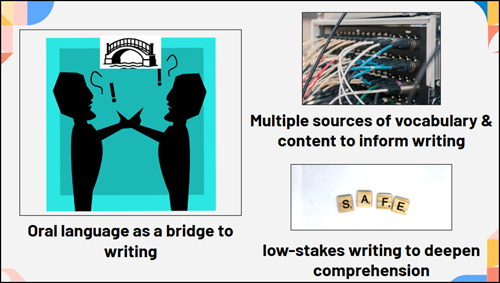
For my part of our Summer Institute workshop “Thinking on Paper: Writing Strategies for Deeper Learning,” I shared a lesson for pre-HSE and HSE learners. My overall goal is to prepare students for an eventual summative writing activity by participating in intentional speaking and listening activities, reading and viewing texts, and demonstrating comprehension and connection through writing. This lesson is designed to be the first lesson in a longer instructional focus on cyberbullying.
Summative Activity:
Are schools responsible for protecting kids from cyberbullying? Defend your group’s position in writing with evidence.
Connecting to Key Vocabulary through Oral Prompts
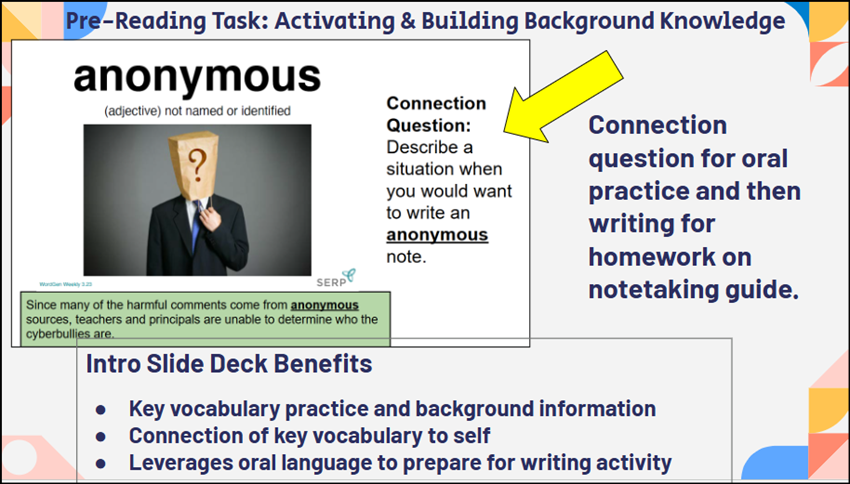
My lesson begins with a focus on key vocabulary words that will appear in lesson texts. Using a slide deck that includes some content from the Word Generation website, students engage in discussion through the connection question provided on each slide. They would also take notes and answer the same vocabulary connection questions in writing with sentence stems for homework.
Low-Stakes Writing about a Short Video
Students would then view a short video about cyberbullying and choose from a set of sentence stems to respond to the video in writing. Sentence stems reduce cognitive load to help students focus on their ideas and connections.
- This video made me feel ___ because ___.
- As I was watching the video, I was thinking about ___ because ___.
- I connected to the video when ___ because ___.
- I think the person who made the video is trying to tell us ___ because ___.
- I am still wondering ___ because___.
Intentional Listening Practice to Build Oral Language Skills
Students share what they wrote about the video in a class discussion, which provides an additional opportunity to practice language structures helpful for collaborative conversation and debate. I would again provide sentence frames for support.
- I agree with your point because ___, and it also makes me think about ___.
- I see it differently because ___, and in my opinion ___.
- I heard you say ___. That connects to ___ because ___.
- When you said ___, it made me think about ___ and how it relates to ___.
Comprehension through Low-Stakes Writing
We would then work with an introductory text, “Are Schools Responsible for Protecting Kids from Cyberbullying?” from the Word Generation website. Following a read-aloud of the text to provide access to all students and an additional read with partners, we would discuss the following comprehension questions first so students can hear a variety of perspectives on the text.
For all students:
- Prompt: In 2–3 sentences, explain the main idea of the article or passage and include one or two important details that support it.
Choose 1:
- Prompt: How is information from both texts similar to or different from something you already knew or experienced? Give at least one example.
- Prompt: Why is the information in these texts important to you or to other adults? Give at least one reason.
Then students would have an opportunity to write their answers to the questions. This type of activity serves as low-stakes writing practice for students, provides an opportunity to deepen comprehension and connection with a text, and gives teachers a window into how students are comprehending.
Access additional general comprehension prompts you could provide to students >>
When we intentionally combine reading and writing in instruction, each can reinforce the other to create opportunities for students to connect to content, deepen understanding, and express thinking in organized ways. By also leveraging oral language as a bridge to writing, we can prepare students to articulate their ideas with greater clarity, build confidence in communication, and transfer those skills to more complex reading and writing tasks in future learning and life.
For more information on combining reading and writing, check out the Just Write! Guide and Writing to Read.