- MN ABE Connect
- Archive
- Better Together: Combining Reading and Writing Activities for Greater Learning
 October 20, 2025
Better Together: Combining Reading and Writing Activities for Greater Learning
As the saying goes, some things are just better together. While this is often said about famous duos like peanut butter and jelly or Netflix and one’s couch, it is also true of reading and writing.
Research tells us that students who read a lot tend to be better writers, and students who write tend to be better readers.
There is something symbiotic about these two skills that comes from analyzing text structure, thinking about language choices, and focusing on meaning. When taught and practiced together, these two skills create a powerful cycle of literacy as each skill strengthens and complements the other.
The reading and writing connection
 Highlighting this connection between reading and writing has been an integral piece of several professional development offerings of which we have been a part, including the Writing Study Circle that was offered through ATLAS starting in 2022. Developing and facilitating this study circle led to us writing an article for the Fall 2023 issue of the COABE Journal and various professional development workshops, the latest of which took place during MN ABE Summer Institute 2025 this past August. In this article, we will dig a little deeper into this reading and writing connection, and why we just can’t stop talking about it.
For our Summer Institute workshop, which was titled “Thinking on Paper: Writing Strategies for Deeper Learning,” we decided to create and share two lessons plans into which writing tasks had been intentionally integrated to complement the reading components. Each lesson plan shared writing tasks that students could complete before, during and after reading a text in order to deepen and demonstrate understanding. Stephanie shared a lesson that had been created for an intermediate-level ELL class, while Kristine’s lesson was geared towards pre-HSE level students.
The text that Stephanie selected was from the website ReadWorks, and it was called “It’s All in the Mind.” This is a pro/con text that explores whether or not psychics are con artists who make money by ripping people off. Stephanie chose this text because it’s on an interesting topic that is not covered in most ELL core textbooks, and so it provides an opportunity for students to unpack a text on an unfamiliar topic, which is a needed skill.
Quick writes
Stephanie’s lesson begins with a quick write activity, which is where students spend a few minutes thinking about and responding to a writing prompt. A quick write is an example of a low-stakes writing task that has been shown to build students’ comfort level and stamina for writing. In a quick write, or related writing activity, the emphasis is on communication and clarity of ideas, so teachers do not need to provide corrective feedback. Students write to share their ideas, activate background knowledge on a topic, and exercise their writing muscles.
Picture prompts for different types of sentences
Another type of low-stakes writing activity that Stephanie modeled during the session was having students create different types of sentences (i.e. simple, compound, and complex) from a single picture prompt. The example shared from the lesson was a picture of a fortune teller gazing into a crystal ball. Session participants created sentences like, “She is telling the future.” and “Some people believe in fortune tellers, but I do not believe in them.”
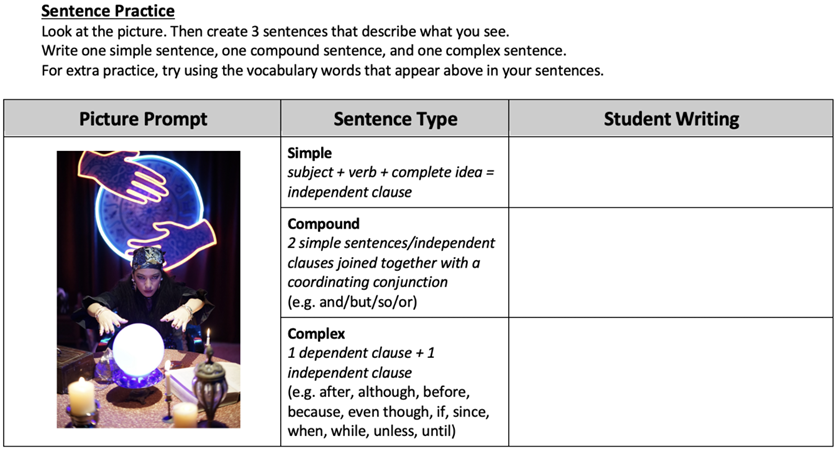
This type of activity exposes students to the important skill of developing sentence variety in writing, and it’s easy to facilitate in an online class by sharing the picture with students and asking them to respond in the chat. For the during reading activities, Stephanie highlighted the impact of text annotations and discussed this task through a writing lens.
Gist summaries
Additionally, the session participants practiced writing a “gist summary,” which is an activity from the website Read,Write,Think. In a gist summary, students are taught to think about “the who, the what, and the why” of a text before crafting a 20-word sentence that captures the main idea.
Assessment and reflection
The final piece of the lesson involved assessment and reflection after reading the text. For this section, Stephanie shared how she took the multiple choice questions that were included at the end of the text and changed them to short answer responses. This simple change, which requires very little prep time, provides an additional opportunity for students to write during a lesson and facilitates a deeper level of thinking about the text. Rather than simply choosing a, b, or c, students have to identify the needed information in the text and place it into a sentence. Sentence stems can be provided for students who need that extra language support. For example, the question “In the past, where did people usually find psychics?” can be answered using the sentence starter, “In the past, people usually found psychics…”
When the session was over, participants left with a few more tools and, hopefully, some inspiration to carry into this school year.
