
- MN ABE Connect
- Archive
- From Mimicking to Sense-Making in Math: Insights from Pam Harris
 September 8, 2025
From Mimicking to Sense-Making in Math: Insights from Pam Harris
Teaching math to adult learners is important and rewarding work–and it brings a lot of unique challenges.
Many students come to us with math anxiety, past trauma, uneven prior knowledge, and a shattered sense of what they are capable of. Others are laser-focused on the test and on the clock, wanting to earn their diplomas yesterday. Most students also arrive with a very teacher-centered, top-down idea of what it means to learn and do math, even though that approach has not worked for them in the past. Not to mention the realities of mixed-level classrooms, and the fact that adult life and responsibilities put pressure on student focus and attendance. It is a lot to carry and a lot to navigate. It’s easy to wonder: What can I actually do here? Where do I begin?
Whether you’re a new teacher or have decades of experience, you’re not alone—these challenges are shared by all of us.
This is where Pam Harris’ work can be a lifeline.
“Math Is Figureoutable”
 Pam Harris is a nationally recognized math leader, learner, educator, author, and speaker. Her work offers a research-based framework and concrete routines that help students—and teachers—develop reasoning, confidence, and understanding together.
One of her core principles is that “math is figureoutable.” That may sound simple, but it is also radical. All students can make sense of math concepts if given the right experiences, supports, and opportunities to reason.
For teachers, it means we don’t have to be the person with all the answers. Our role isn’t to stand at the front of the room and deliver steps for students to memorize. Instead, we get to notice, guide, and nurture students’ reasoning. That shift takes a huge weight off our shoulders. We don’t need to be walking workbooks or calculators—we need to be curious with our students, notice their strategies, and help them build from where they are.
Pam’s pedagogy comes from a career of working with all types of math learners. Her work now is dedicated to helping teachers reframe their instruction about the reasoning of their students.
The Development of Mathematical Reasoning
One of the tools Pam created is this model for the development of mathematical reasoning.
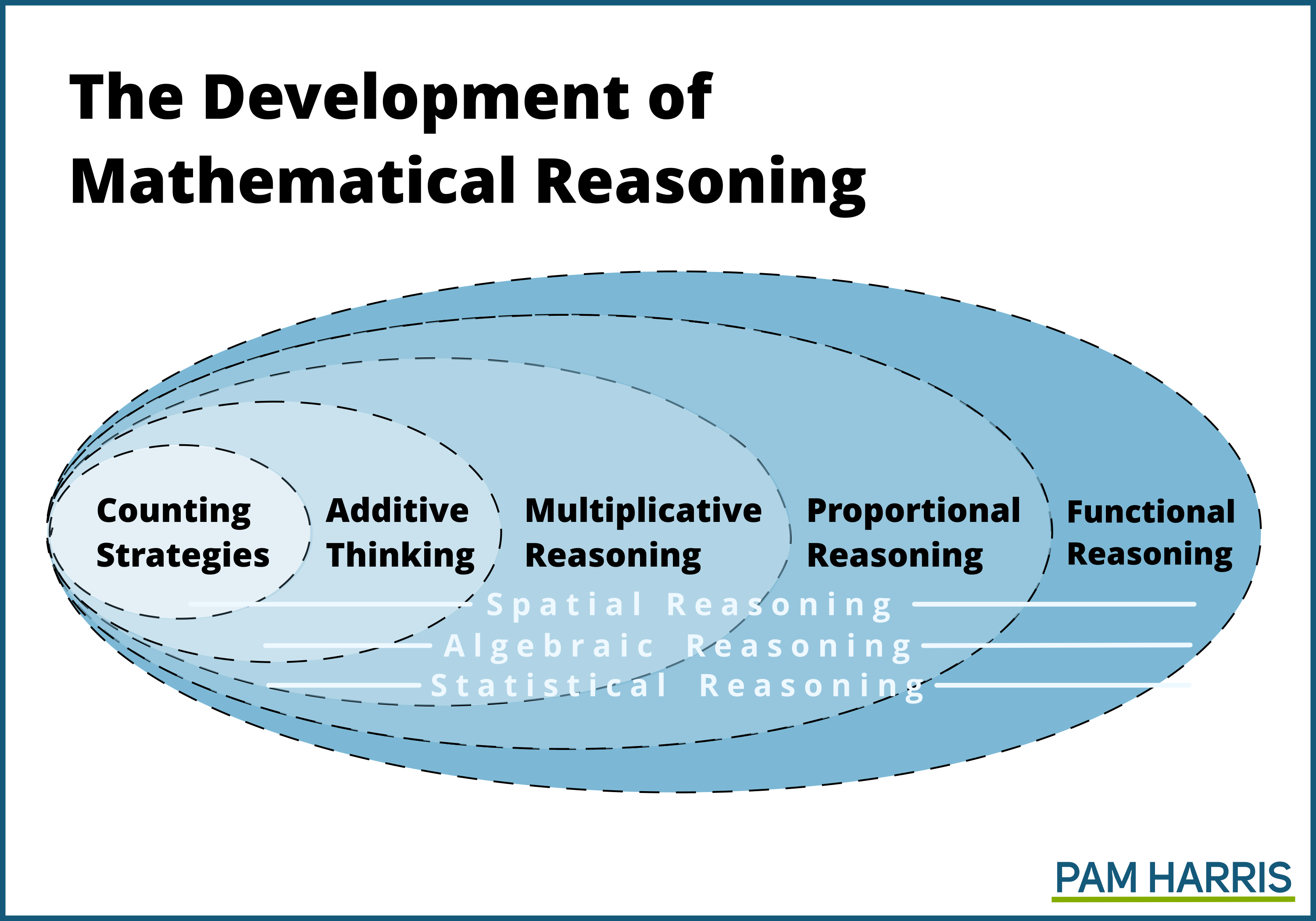
What do you notice? What do you wonder?
One thing you may be wondering is what is the difference between multiplication and multiplicative reasoning. I would say, multiplication is the operation itself—the act of combining equal groups. Multiplicative reasoning is the ability to solve problems using larger, more efficient chunks than counting by ones. For example, instead of only knowing 7 × 7 is 49 through memorization, a student with multiplicative reasoning can see the structure of 7 × 7. They might think, “I don’t know 7 × 7, but I do know 7 × 5 and 7 × 2.” This kind of thinking is not just about recalling facts; it is about flexibility and fluency that can be applied to more complex concepts and problems.
You also might be asking yourself, isn’t this just the order of topics in the CCRS? Not quite. The standards focus on what to teach; Harris’ model focuses on how students are reasoning. That shift helps teachers see the strategies students use, where they get stuck, and what kind of reasoning they’re ready to develop next.
Pam’s model of mathematical reasoning gives us a way to understand our students’ thinking—whether they’re still counting by ones or starting to see patterns and relationships. Instead of feeling lost when a student struggles, you’ll have a roadmap: “Ah, they’re reasoning additively here. How can I nudge them toward multiplicative reasoning?”
Problem Strings: Learning Journeys, Not Worksheets
Pam Harris has also done a lot of work with instructional routines. One of them is the problem string. A problem string is a sequence of related problems that guide students step by step into deeper understanding. They help teach specific content, while making student reasoning visible and actionable.
 Problem strings are gold, for new and experienced teachers alike. They’re not just worksheets; they’re learning journeys. They give teachers a structure to lean on, while letting students do the sense-making. The problem string resources that Pam has created help teachers learn how to ask questions that promote sense-making as opposed to just checking answers.
For adult learners, this approach matters. So many students arrive in our classrooms having internalized the idea that math is a private club and that they are not welcome. If we jump straight to having students memorize procedures without reason, we risk reinforcing students’ fears and low expectations: “See, I can’t do this. Just tell me how to do it. I am not a math person.”
When we invite them to reason—to figure things out in ways that make sense to them—we help them see themselves in a new way and learn math in a way that is figureoutable. We can show them that math isn’t about remembering rules they missed years ago. It’s about thinking. Instead of, “I’m trying to remember how to do this,” it’s “I’m trying to figure out what I know and how I can use it to learn what I don’t know yet.”