
- MN ABE Connect
- Archive
- Goodbye Lexile, Hello ATOS: Shifts in Measuring Quantitative Text Complexity
 September 8, 2025
Goodbye Lexile, Hello ATOS: Shifts in Measuring Quantitative Text Complexity
When we started to measure text complexity in line with the College & Career Readiness Standards for Adult Education (CCRS) 10 years ago, many of us turned to Lexile, which was both suggested by the CCRS as a quantitative measure of text and a familiar measure to those of us who currently worked in—or had worked in—the K-12 system.
 Recently, Minnesota decided to discontinue its state partnership with Lexile, so we are no longer eligible to use the Text Analyzer Tool without a Premium membership. Fortunately, we also have the ATOS Analyzer Tool to help us find an initial quantitative measure of text.
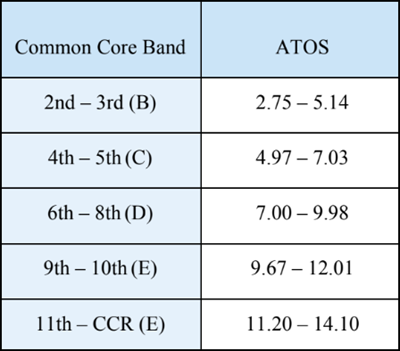
Unlike with the Lexile Text Analyzer Tool, the ATOS Tool does not require you to create an account. You can paste text in directly or follow instructions for uploading text into the tool. Once you get the text’s quantitative score, you can then compare it to the number bands included in CCRS Reading Anchor 10 to determine if the score falls into an appropriate level for the students you teach.
Find instructions for how to use the ATOS tool and how to read and understand the results >>
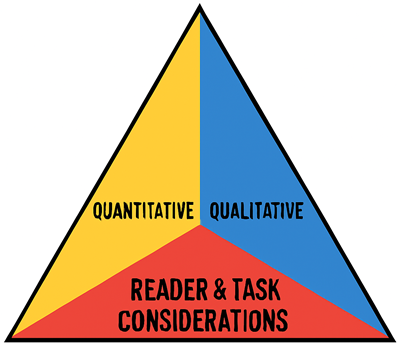 As a reminder, using a quantitative measure such as Lexile is part of the three-part model for measuring text complexity that includes quantitative and qualitative dimensions as well as reading and task considerations. Quantitative algorithms generally measure the surface level of texts: word length and frequency, sentence length and complexity of clauses, and overall repetition of key words and inclusion of transition words. This initial measure of text can be useful for getting an objective, initial idea of the surface demands of a text and can give us a rough idea of whether a text is within a range appropriate for a group of learners.
Remember that text complexity is made up of a combination of factors, including quantitative measures, qualitative measures, and reader and task considerations. A quantitative measure, such as Lexile or ATOS, gives us a base measure of a text, but it does not measure other factors that can increase the complexity of a text for our learners. Text structure and features, language clarity and conventions, knowledge demands and clarity of purpose can present complexity for adult learners beyond a quantitative score. These factors require a human to identify.