

ESL Resources
English Reading Demystified
BATT: Additional Resources
Cracking the Code: Adult ESL Classroom Videos
Cracking the Code: Dyslexia and Reading Disabilities
Cracking the Code: English Reading Demystified

The content for this resource stemmed from a study circle of four adult English as a Second Language (ESL) teachers whose learners range from pre-literacy to advanced levels of ESL instruction. The educational backgrounds of these learners vary widely, but a significant number have had limited formal education and many never acquired literacy in their native language.
In the classroom, we observed our English Language Learners (ELL) struggling with various elements of alphabetic print literacy including phonemic awareness, phonics, print awareness, fluency, comprehension, and writing. We noticed that the difficulties ELLs experience are extremely similar to the difficulties experienced by learners in another field of literacy: dyslexia.
To enhance our own practice and to contribute to an area with limited research, we completed a study circle that intentionally connected adult ESL literacy and K-12 dyslexia/reading disabilities education.
While the two contexts are different in many ways and our language learners are likely not dyslexic (there is currently no way to diagnose ELLs), we found much that overlaps. By purposefully learning more about instruction for learners with dyslexia, we enhanced our own teaching of adult language learners across all levels.
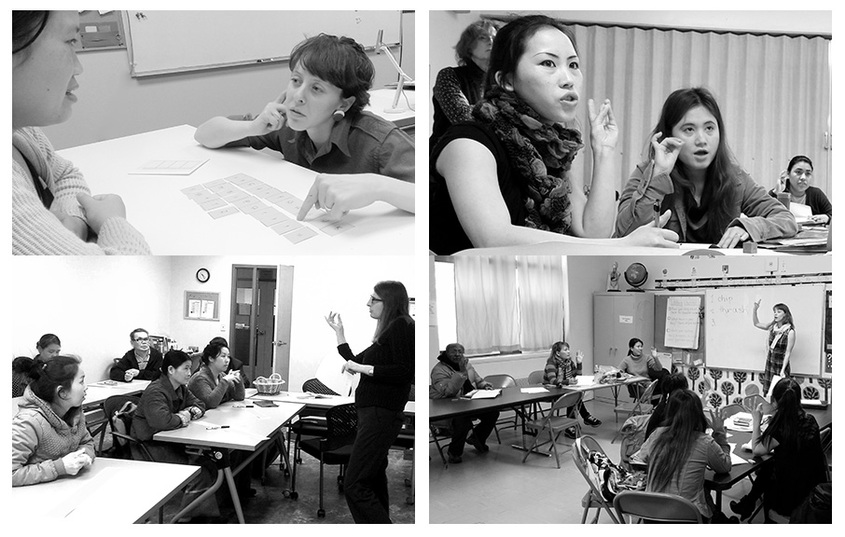
Remember those grade-school rules like I before E except after C, and adding an E to the end of a word makes for a long vowel? Ever wonder how much of English reading can be explained so simply? You may be surprised to learn that although the English sound system appears chaotic and unpredictable, there are consistent patterns that are completely teach-able.
Crack the code with us! This resource focuses on making this complex system more transparent. The information here is appropriate for anyone wanting a firm grasp of the ins and outs of basic English reading, with particular emphasis on ESL.
Content includes demonstrations of code-cracking activities, video clips from Adult Basic Education (ABE) classrooms, and an introduction to a scope and sequence that can enhance your current teaching of ESL reading.
This resource also draws from part of a presentation at the ATLAS Adult ESL Institute, in Burnsville, MN on May 15-16 2014. Initial funding for this project was provided by a COABE Incentive grant.
Presentations on this topic:
Cracking the Code: English Reading Demystified – from ATLAS Adult ESL Institute, May 2014
Crossing Contexts Teachers of Low-literate ESL Learn from Dyslexia Educators – from ATLAS Metro ABE Regional Event, May 2014
Cracking the Code: Materials
Cracking the Code: The Wilson Reading System
English Code Crackers: BATT Tests
Access the BATT >>
Important Testing Notes:
This section presents teacher-friendly tests for determining which Roman alphabet letters and/or English letter-sound patterns are known and unknown by individuals or groups of students (up to about 15-16). Some important test or testing information:
- All tests include teacher directions, student pages, and answer keys.
- Use your teacher knowledge of students’ reading strengths and needs to select an appropriate ‘starting test’. If it is too hard, go back. If it is too easy, go forward.
- Alphabet letter knowledge is tested with pointing, naming, and writing.
- Single consonant knowledge is tested with sound dictation and spelling.
- Short vowel sound knowledge is tested with minimal trios of simple words.
- Other consonant and vowel knowledge is tested with word dictation and spelling, which is considered a valid measure of important phonological processing skills.
- Not all tests or items need to be given. Stop testing when you have what you need to plan instruction or if students begin to show test fatigue or frustration.
- If certain testing processes or test items are confusing for students, change the steps, orders, or words as needed.
Tests
-
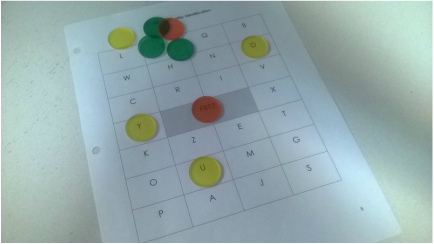
Test 1: Alphabet Letter Identification (Bingo Template: BATT, p. 70) Uppercase Letter Identification – p. 10
- Lowercase Letter Identification – p. 11
- Letter Naming (upper and lowercase) – p. 12
- Letter Writing (upper and lowercase) – p. 13
- Single Consonant Knowledge – p. 14
- Short Vowel Knowledge – pp. 15-16
- Consonant Blend and Short Vowel Knowledge – p. 17
- Consonant Digraph/Trigraph and Short Vowel Knowledge – p. 18
- Long Vowel Silent-e and Vowel Digraph Knowledge – p. 19
- Vowel-R and Vowel Diphthong Knowledge – p. 20
English Code Crackers: BATT Tools
Access the BATT >>
Important Teaching Notes:
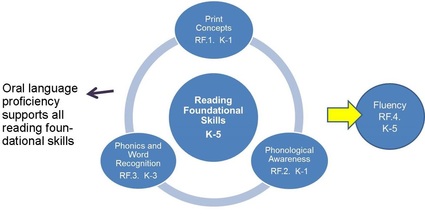
This section presents instructional practices, orders, approaches, lesson plans, more activities, and other materials or resources (see under Additional Resources>BATT). The five lesson plans are aligned with the four Reading Standards: Foundational Skills (K–5). Specifically, these skills include:
- RF.1. Print Concepts: knowing left>right, spoken>written, words+ spaces=sentences, upper and lower case alphabet letters
- RF.2. Phonological Awareness: counting, pronouncing, blending, and segmenting sounds, syllables, and onsets + rimes into words
- RF.3. Phonics and Word Recognition: knowing and applying single consonants, short vowels, digraphs, blends, vowel teams, sight and irregular word skills
- RF.4. Fluency: reading grade-leveled text with purpose, accuracy, appropriate rate, expression, understanding, and self correction
ABE/ESL students’ beginning alphabetics or reading foundational skills will likely vary; however, there are three adult reader profiles that can guide ‘entry points’ for instruction. The test results identify the specific letter-sound-word skills that need to be taught and learned.
Additional Considerations:
- Many pre-literate and non-Roman alphabet ESL students need to start at the very beginning and develop all Print Concepts.
- Many semi-literate ESL students with previous alphabetic experience and some ABE students with life-long, reading difficulties know the Print Concepts, but need to develop their Phonological Awareness, Phonics and Word Recognition.
- Many ABE students and educated ESL students know Print Concepts and have Phonological Awareness, but have gaps in their consonant and vowel knowledge and application to unfamiliar words. They need to expand their Phonics and Word Recognition.
Lesson plans 1-4 (included below) are intended to develop a blend of Print Concepts, Phonological Awareness, Phonics and Word Recognition at these entry points. Because all beginning (and intermediate) ABE/ESL students also need to develop Fluency, short ‘word to text’ activities are included at the end of each plan. Lesson plan 5 describes more fluency steps and techniques for guided oral reading of shorter text (phrases or sentences) and longer, connected text (stories, articles, passages, or books).
Instructional Practices
These evidence-based reading instructional practices are recommended for all beginning readers of all ages, from children to adults.
ALL ALPHABETICS INSTRUCTION SHOULD BE SEQUENTIAL AND SYSTEMATIC.
- The English language includes between 42-44 sounds. Some are formed by one letter and others by a combination of two or three letters. At least 20 sounds are 90% predictable and another 10 are 80% predictable. Teaching alphabetics sequentially and systematically means progressing from simple to complex, common to less common, and predictable to less predictable letter-sound-word patterns. It also means encouraging students to rely on reliable patterns that work 84% (or most) of the time.
ALL ALPHABETICS INSTRUCTION SHOULD BE EXPLICIT AND MULTISENSORY.
- Teaching explicitly means scaffolding from teacher modeling (“I step”) to teacher-student guided practice (“We step”) to independent student application of taught skills (“You step”). This explicit process ensures ample opportunities to achieve mastery and proficiency of reading (and writing, math) skills.
- Multisensory alphabetics instruction (VAKT) links visual (seeing or looking), auditory (listening or hearing), and kinesthetic-tactile (touching or feeling) modalities. It is based on the work of Samuel Orton, Anna Gillingham, and Bessie Stillman and sometimes called Orton-Gillingham or OG. It has been used extensively and successfully with children diagnosed with specific learning disabilities or dyslexia. For more detailed information, see under resources>Code Crackers. Here is a simple multi-sensory letter-sound-word process optimizing all three modalities:
-
- Teacher cuts and distributes small squares of sandpaper, fleece, or fun fur
- Teacher shows a letter and says the name
- Students repeat the name as they write (and feel) the letter
- Teacher shows a letter and says the sound
- Students repeat the sound as they write (and feel) the letter
- Teacher shows and says a word
- Students repeat the word as they write (and feel) the letters
ALL ALPHABETICS INSTRUCTION SHOULD BE INTENTIONAL AND ROUTINE.
- Although challenging to organize in many ABE/ESL classrooms, routines benefit both teachers and students. They provide a predictability that decreases teachers’ planning and preparation time and increases students’ anticipation and engagement in reading instruction. Teaching alphabetics intentionally and routinely means purposely offering regular lessons for 10-40 minutes/day, 2-5x/week, over many months (if not years…).
Instructional Order
This chart presents the Roman alphabetical order and an English letter-sound instructional order that progresses from simple to complex, common to less common, and predictable to less predictable or irregular. Because vowel sounds tend to be more difficult to teach and learn, sample words are provided for teachers.
Three Phonics Instructional Approaches
Below are brief descriptions of three approaches for teaching any recommended order of English letter-sound-word patterns. All are sequential, systematic, explicit, and multi-sensory. All can be delivered in short, daily lessons offered regularly during the week over many months.
- Analogy (meaning comparing things based on their similarities) teaches phonograms (or rimes) and their related word families (formed by adding onsets or consonant patterns at the front). For example, a teacher shows and says the phonogram -ab. He/she models how to add the single consonants c, d, g, j, l, n, t at the front to form similar relatives: cab, dab, gab, jab, lab, nab, tab. Then he/she guides students in reading and spelling the same word family.
- Analytic (meaning separating something into components or parts) teaches analysis of letter-sound patterns in known words and application to unknown words. For example, a teacher shows and explains short vowel a and long vowel a-silent e headers, which include phonetic spellings, example words, and sometimes pictures. He/she models how to sort (or separate) by headers a list 12-21 other words: mad, fast, page, name, same, hand, snap, came, grass, rake, made. Then he/she guides students in reading, sorting, and spelling the same words.
- Synthetic (meaning combining different substances or components) teaches individual letter-sound patterns, blending, and segmenting of recognizable words. For example, a teacher shows and says the consonants m, l, s, t and short vowel a. Students practice saying the sounds and the teacher models how to blend (or combine) them into small words: am, Sam, tam, Al, Sal, as, mat, at, sat. Then he/she guides them in reading and spelling the same words.
Synthetic is the most common phonics approach and used in many print, software, and online instructional materials. It is the best approach for ABE/ESL students who need to acquire or improve knowledge of single letters and single sounds. It is used in lesson plans 1-2. Analogy and analytic generally require knowledge of at least single letters and single sounds. They are used in lesson plans 3-4. If appropriate for students or the class, use a combination of two or three phonics approaches to motivate and engage them the long process of learning to read, recognize, and spell words.
Five Lesson Plans
- Print Concepts and Phonological Awareness
- Phonological Awareness, Phonics, and Word Recognition
- Phonics and Word Recognition
- Phonics and Word Recognition
- Fluency
- Lesson Plan Template – p. 36 of BATT
English Code Crackers: the BATT
Beginning Alphabetics Tests and Tools (BATT) strives to provide a ‘principled’ system for ABE/ESL teachers who want and/or need to develop their students’ knowledge of Roman alphabet letters, English letter-sound patterns, sight or high frequency words, and transfer of those letter-sound-word skills to text fluency and comprehension. BATT includes (1) teacher-friendly tests for determining known and unknown skills, (2) evidence-based reading instructional practices, orders, approaches, and lesson plans for teaching unknown skills, (3) teacher-tested lists of other activities and materials, and (4) time-saving teacher resources.
BATT is closely aligned with four Reading Standards: Foundational Skills (K–5) from the Minnesota Academic Standards (MDE, 2010) and Career and College Readiness Standards for Adult Education (OCTAE, 2013):
- RF.1. Demonstrate understanding of the organization and basic features of print. (Print Concepts)
- RF.2. Demonstrate understanding of spoken words, syllables, and sounds (phonemes). (Phonological Awareness)
- RF.3. Know and apply grade-level phonics and word analysis skills in decoding words. (Phonics and Word Recognition)
- RF.4. Read with sufficient accuracy and fluency to support comprehension. (Fluency)
Developing Reading and Writing, a highly respected booklet based on Improving Adult Literacy Instruction: Options for Practice and Research (NAP, 2012) – an extensive report from the National Research Council of the National Academies – summarizes evidence-based principles shown to be effective for developing readers. The authors state all the principles “apply to all adult literacy learners, including those learning English as a second language and those with learning disabilities” (page 1). The five principles are:
- Use explicit and systematic reading instruction to develop the major components of reading – decoding, fluency, vocabulary, and comprehension – according to the assessed needs of individual learners.
- Combine explicit and systematic instruction with extended reading practice to help learners acquire and transfer reading component skills.
- Motivate learning through learners’ engagement with the literacy tasks used for instruction and extensive reading practice.
- Develop reading fluency to facilitate efficient reading of words and longer text.
- Explicitly teach the structure of written language to facilitate decoding and comprehension.
BATT Tests
Find teacher-friendly BATT tests >>
BATT Tools
Acknowledgements*
Developed by:
Marn Frank, ATLAS Literacy & STAR Coordinator
Kristin Perry, Hmong American Partnership ESL Teacher
The developers, Marn Frank and Kristin Perry, extend a gracious thank you to these MN ABE/ESL language and literacy teachers, who contributed their valuable piloting time, insightful feedback, teacher-tested tools, and inspiring testimonials: Erin Evans, Lincoln Adult Education, ESL Teacher; Emily Fischer, Central MN ABE-St. Cloud, ESL Teacher; Kristin Klas, Hmong American Partnership, ESL Teacher; Lori Leininger, Robbinsdale Adult Academic Program, PANDA Coordinator; and Eleanor Purdy, Minnesota Literacy Council, ESL Teacher.
*NOTE: All affiliations listed for the developers and contributors of this work are from 2014.
English Code Crackers: the Developers
 Marn Frank, MEd, served as the Literacy & STAR (STudent Achievement in Reading) Coordinator for ATLAS until 2021. Over a span of nearly 40 years, she worked as an elementary teacher, special education teacher, adult basic education (ABE) teacher/coordinator, learning disabilities specialist, and trainer in evidence-based reading instruction for adults. Her passion for helping ABE teachers and students ‘crack the code’ was been inspired by many wonderful professional and personal experiences across the years.
Marn is now retired.
 Kris Klas, M.Ed., is an ABE instructor in St. Paul, MN. They have over 10 years of experience teaching English as a second language. Kris has taught literacy level students for almost 9 years and has focused their studies and professional development on teaching adult English language learners with limited formal education. Kris believes multisensory instruction makes literacy achievable and fun!
Student practice page: teacherkristin.weebly.com
Numeracy for literacy level learners: numeracyforlife.weebly.com
 At the time of the creation of this resource, Kristin Perry was an intensive ELL instructor at Hmong American Partnership in St. Paul, MN. She came into ESL after a career in photography and has taught language, literacy and numeracy to beginning learners. She has a TEFL through Hamline University and is also certified in research-based reading strategies through the Dyslexia Institute of Minnesota. She has been blown away by the progress she’s seen in struggling readers who have been introduced to the type of instruction shown on this site and is thrilled to share the excitement with colleagues.
Kristin balances out the logical/research focused side of herself with fine art photography, for a glimpse into the creative side of Kristin: presenttobeauty.com
 Patsy Egan, PhD, is the Director of ATLAS, housed in the Hamline University School of Education & Leadership. She holds a BA in Russian Language from the University of Nebraska, as well as an MA in English as a Second Language and a PhD in Curriculum & Instruction (Second Languages & Cultures) from the University of Minnesota. She has taught adults since 1994, working extensively with adult immigrants and refugees in Nebraska and Minnesota.
Patsy’s teaching and research focuses on literacy development and teacher education for adult learners, including Adult Basic Education (ABE) and English as a Second Language (ESL) – and particularly those learners with limited literacy in their first languages. How to teach reading to such learners, and how to prepare their teachers for excellent literacy instruction, has always captured her attention. She was delighted to collaborate with local classroom teachers Kristin Perry and Kris Klas in ‘cracking the code’ for English language learners.
ATLAS website: atlasabe.org/about/staff/patsy-egan